




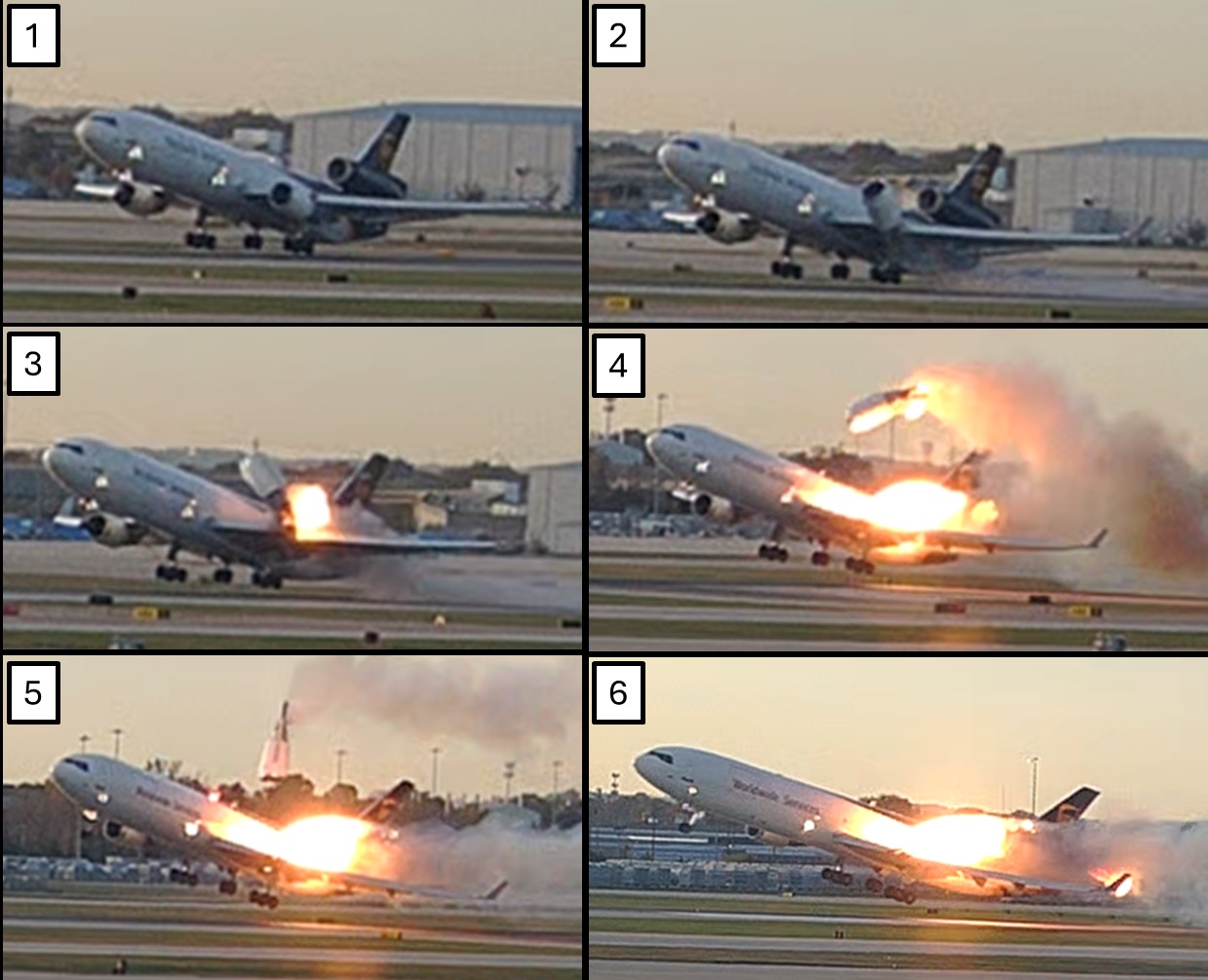

The National Transportation Safety Board (NTSB) released its preliminary report Thursday of the Nov. 4 UPS MD-11F cargo jet that crashed shortly after takeoff in Louisville, Kentucky. The aircraft was unable to stay airborne after its left engine and pylon separated from the wing, according to the report.
Fourteen people were killed, including the three crewmembers aboard and 11 people on the ground, when UPS flight 2976 struck several buildings just beyond Louisville Muhammad Ali International Airport on November 4.
Investigators said airport surveillance video showed the No. 1 engine and its pylon detaching moments after rotation, igniting a fire near the pylon’s wing attachment point. The MD-11F climbed no higher than about 30 feet above ground level before descending into nearby industrial structures.
Engine Separation and Initial Impact
According to the NTSB, the airplane’s taxi and takeoff roll appeared normal until rotation. Video footage reviewed by investigators showed the left engine breaking free, traversing over the fuselage, and falling to the ground. A fire erupted immediately at the wing-pylon junction, the agency said.
Flight data recorder (FDR) information indicated the airplane briefly became airborne, and it managed to clear the height of the airport’s blast fence. The jet’s left main landing gear struck the roof of a UPS Supply Chain Solutions warehouse just beyond the runway. The MD-11F then traveled through a storage yard and two additional buildings—including a petroleum recycling facility—before coming to rest about 3,000 feet from the initial impact point.
A tower controller observed that the takeoff speed appeared typical for the aircraft type but said the climb rate “was not normal,” according to the report. Another witness said the jet stopped climbing, lost altitude, and rolled slightly left before impact.
Early Evidence of Structural Failure
Recovered wreckage showed significant fragmentation and fire damage across a wide debris field, the report noted. The left pylon’s aft mount was found with both the forward and aft lugs fractured, and the spherical bearing connecting the pylon to the wing had separated. Materials laboratory examinations found evidence of fatigue cracking on multiple fracture surfaces.
A portion of the wing clevis remained attached to the spherical bearing and hardware. The bearing’s outer race had fractured circumferentially, exposing the ball element. Investigators said additional examinations are underway to determine the extent and origin of the fatigue damage.
The right engine remained attached to its pylon, though its mounts ultimately separated during the crash. Several fragments from the left engine’s fan blades were found along runway 17R.
Crew, Maintenance, and Safety Actions
The cockpit voice recorder captured the entire flight, and both recorders are being analyzed by dedicated NTSB groups. The captain, identified as the pilot monitoring, had 4,918 hours in the MD-11. The first officer, who was flying, had 994 hours in type, while the relief officer had logged 8,775 hours in the MD-11.
Maintenance records showed the left pylon aft mount underwent required visual inspections in 2021. Lubrication of the pylon thrust links and spherical bearings was completed in October 2025. Certain special detailed inspections related to cycle limits were not yet due for the accident aircraft.
UPS grounded its MD-11 fleet three days after the crash at Boeing’s recommendation. The FAA subsequently issued two emergency airworthiness directives restricting operations of MD-11 and DC-10 series aircraft until additional inspections and corrective actions are completed.
The NTSB’s investigation into UPS flight 2976 remains active, and the agency cautioned that all findings in the preliminary report are subject to change.


0 replies