




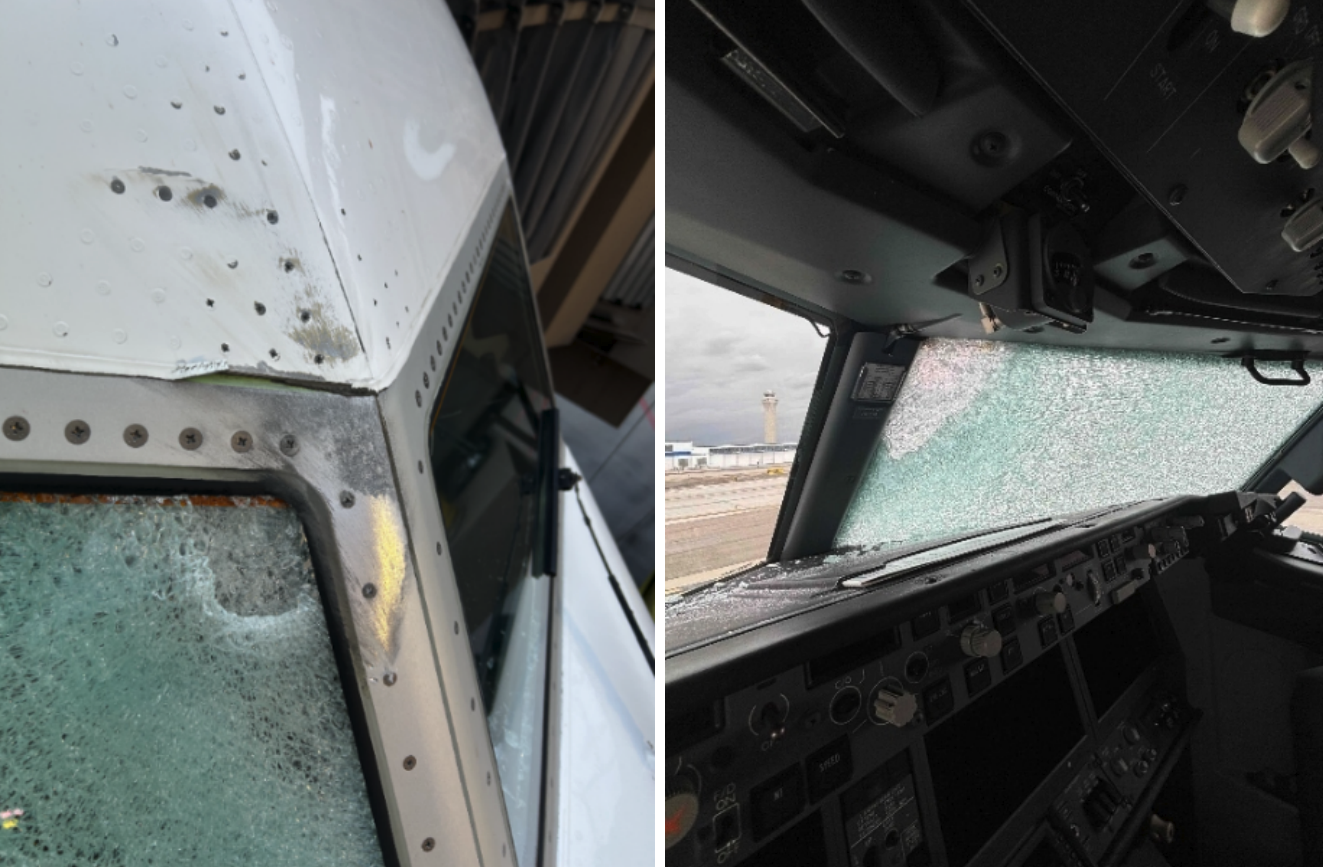

The National Transportation Safety Board (NTSB) released its preliminary report on the Oct. 16 windshield strike incident involving United Airlines flight 1093 over Moab, Utah. The Boeing 737-8 was forced to divert to Salt Lake City after an object hit the first officer’s forward windshield during cruise at 36,000 feet. Glass entered the cockpit during the impact and left the captain with minor injuries, although aircraft pressurization remained stable for the duration of the flight. The captain later resumed flying duties for the descent and landing, which occurred uneventfully, and no other occupants reported injuries.
The report said the captain saw an object on the horizon moments before the strike. Flight data showed the 737 tracking southwest with a groundspeed of 395 knots at 36,002 feet at the time of impact. The NTSB also confirmed that a WindBorne Systems Global Sounding Balloon (GSB) passed through the same area at nearly the same altitude and stopped transmitting shortly following the event. Its last reported altitude was 35,936 feet, along a track nearly reciprocal to the airplane’s. The GSB was launched from the ground in Spokane, Wash., on October 15.
The balloon’s manufacturer, Windborne, told investigators that the GSB is designed using no large metal components or “high-stiffness” structural parts in order to minimize any damage in the event of a collision.
Investigators sent the damaged windshield to the NTSB Materials Laboratory for examination and are still reviewing data from the flight data and cockpit voice recorders. Specialists in materials engineering, meteorology, aircraft performance, operations and air traffic control joined the investigation, along with technical representatives from the FAA, WindBorne, Boeing and United.

Some Chinese spy balloon no doubt.
Chinese spy balloon? Another off the cuff, nonsensical, drivel-driven conspiracy theory, unsupported by facts or logic. Sheesh.
It used to be “big sky, small airplane” but that’s no longer true with all the balloons, falling space debris and drones. If you hit anything at 395 kts, it will make an impression no matter how it’s constructed. Part 108 will make this worse by filling the lower altitudes with autonomous drones. It’s human nature not to worry about something until it smacks us in the face but by then it’s usually too late for a simple fix. Better on-board radar is the only solution that I can see.
Except the company that owns the balloon said it was one of theirs the day after it happened.
Sorry to burst your conspiratorial bubble, or balloon as it were
Really… so you didn’t see all the confirmed ones over continental USA a year or so ago…
Include a small ADS-B out transmitter in these weather balloons?
The Chinese spy balloon comment was satire.
Seems like a transponder and/or ADS-B might’ve avoided this incident?
Anything in the sky going above 300 feet or within 2 miles of a public airport should be required to be adsb-out-equipped. It’s just too busy out there these days for big-sky thinking. This would also eliminate the constant deluge of useless drotams.
makes sense that something like this needs to be done. I was flying over western Montana a few summers ago, 10K feet, beautiful day, and had to alter course to avoid hitting a weather ballon. The main problem was not being able to see it until it was fairly close. I’m glad that I wasn’t in the clouds at the time.
ADS-B out is the obvious solution. Of course airliners aren’t yet required to have ADS-B in. TCAS needs to be updated to act on ADS-B data.
Yet another reminder that “see and avoid” doesn’t work.
Hmm, but Windborne’s balloons are the reusable type that can make multiple ascents and descents over a period of days without “landing” (instead of launching multiple balloons). Presumably it has some sort of onboard equipment that enables altitude control. It also has a sandbag for ballast. Hitting a bag of sand at a jet’s cruising speed can do damage equivalent to a “high-stiffness” structural part.