




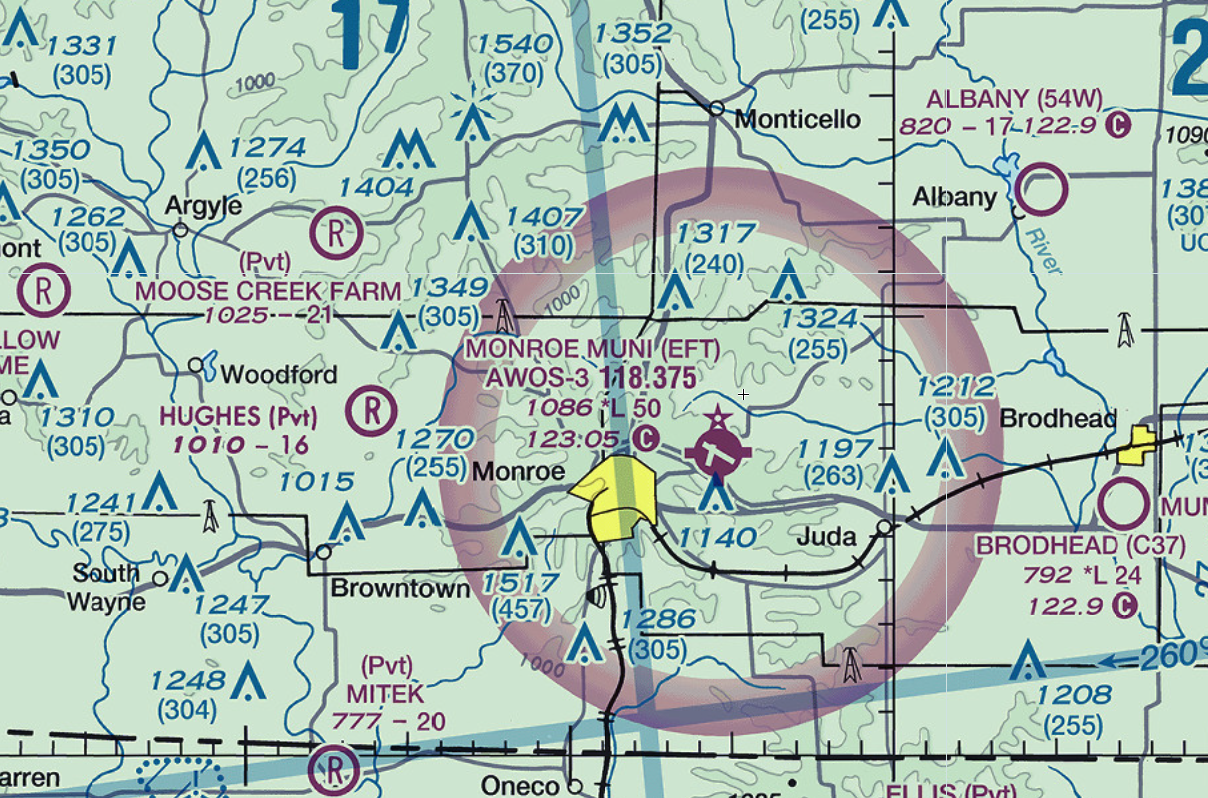

Two people were killed Monday evening when a Socata TBM-700 crashed during an approach to Monroe Municipal Airport (KEFT), a non-towered field in southern Wisconsin. The aircraft, registered as N700PT to a Santa Barbara, California, owner, went down at around 5:15 p.m.
Initial response and scene conditions
Green County Deputies told local news outlet WMTV that the turboprop impacted a gravel quarry north of the airport, where arriving crews found burning construction equipment and large sections of aircraft debris.
According to ADS-B data, the TBM departed Wisconsin’s Oshkosh-Wittman Regional Airport (KOSH) at about 4:40 p.m. for the short flight to Monroe. ADS-B tracking appeared to show the airplane on approach to Runway 20 before the crash.
METAR data from around the time of the accident included quarter-mile visibility with fog and an overcast ceiling at 300 feet. As the aircraft neared the north side of State Highway 59, ADS-B data showed the aircraft initiated a climb roughly a quarter mile from the runway. It ultimately turned toward the northeast before coming to rest at the gravel quarry.
Although the aircraft appeared to be on a final approach path for Runway 20, KEFT only has published approach procedures for Runways 12 and 30. These include RNAV approaches for Runways 12 and 30, as well as a VOR/DME for Runway 30. ADS-B data does appear to show the aircraft was initially on the approach for Runway 12, before initiating a left turn toward the north and then circling back south toward runway 20.
Ongoing investigation
Local fire departments from Monroe Rural and Juda responded to extinguish the post-impact fire.
Officials have not released the names of those on board. The FAA and National Transportation Safety Board are investigating the Wisconsin plane crash, with the NTSB noting in a post on X that it opened an inquiry into the crash. The aircraft, manufactured in 2003 and powered by a Pratt & Whitney Canada PT6A-64 engine, was destroyed in the accident.
Another TBM-700 flight resulted in a fatal crash in Massachusetts last month.


First of all my condolences to the families affected.
That said, we as GA pilots have to do better. Looking at the approach plates for EFT, there are no approaches with less than 400 feet minimums and 1 mile visibility. And there is no vertical guidance on any approach.
While part 91 has the right to do a ‘look see,’ are we really considering an approach with weather reported below minimums? Are we mentally prepped for a missed approach?
Not going to say I have never done the look see, but, I was prepped for a missed and a divert. Best we all adopt this state of mind.
I have flown over quarries before. Always in good weather, because I’m a VFR pilot. They can be every bit as bad as mountain flying, with unexpected updrafts and down drafts, depending on the wind conditions. I’m not saying that this had anything to do with the accident, but it could certainly have been a contributor.
I don’t agree with Matt’s assessment at all. The ADS-B track log data on FlightAware doesn’t show anything that looks like turning to Runway 20. On the contrary, it looks like a normal approach to Runway 12, an attempted missed approach, and a loss of control (overrotation? airspeed drops precipitously while altitude increases rapidly) upon initiating the climb. Spatial disorientation?
Flight Track Log N700PT 24-Nov-2025 (KOSH-KEFT) - FlightAware
Yes, condolences to the family. Appears they should have gone back to Wittman Field, Oshkosh. Over confidence in actual fog appears to be the cause. Not tracking everything going on and loosing control - spacial disorientation as stated by others.
Totally agree (except that it’s rwy 12, not 13–not a big deal). I can’t figure out, given the very graphic ADS-B data, how he could surmise that they were trying an approach to rwy 22.
The missed approach procedure for that approach calls for a straight out climb to 3000 feet to a waypoint, followed by a turn to the southeast. ADS-B shows him turning northeast almost immediately after starting the miss, so whatever happened, he was not following the charted missed procedure.
It also appears the instrument approaches are to Runways 12 and 30. Is there a typo in the article?
Well, yes he didn’t fly the published missed path, but the track log seems to show the aircraft departed controlled flight almost immediately upon initiation of the climbout. That would explain the apparent failure to climb straight ahead, which the pilot may well have been trying to do but lost control in the process.
No, I did that one all by myself.
Looks like a torque roll to me on the missed approach. The TBM’s will do that with lazy feet and too much power applied too fast! Just my two cents
The ADS-B data appears to me as though it may be consistent with the charted Rwy 12 RNAV approach. The ground speed decreases throughout the final approach segment until reaching an ADS-B altitude of 1,500’ and 109 knots GS. At this point on the approach, the ADS-B altitude was indicated as 1,500’, the MDA for the straight-in to rwy 12. The circling mins on the IAP is charted only a little higher than the straight-in mins and the ADS-B target appears to maneuver to the North, perhaps consistent with circling for rwy 20. If the airport environment were spotted near the point where the change in course occurred and at 1,500’ MSL, (400’ HAA) it may have required a steeper than normal descent to land on the first third of Rwy 12 and could have acted as a trigger for the pilot to attempt to circle to Rwy 12.
Obviously this scenario is just armchair speculation after the fact, (MMQBing) but the data appears as though it may be consistent with the scenario as presented.
Maneuvering at or near minimum circling MDAs is perhaps some of the most difficult and challenging flying that can be done under IFR. The transition from instrument to visual control has been a factor in a great many low altitude loss of control accidents.
Please plan, brief and fly safely
Hello;
My friend was involved in this crash as a passenger. The information that I was told from pilots close with him is that this was a new plane his friend had purchased. They did a miss approach and then something happened with the power and autopilot. The plane had a turbo prop thus the plane naturally went to the left.
I am deeply saddened by this as I was planning on seeing him today. I wish my friend did not go flying that day. I now will not see him at the EAA airshow this year
This accident saddens me, too, as I had been with these two guys just two weeks ago at the OSH QB meeting. I’ll miss them. RIP.
No one circles to a shorter runway in ¼ mile 300’ weather. This was clearly a loss of control during a missed for RW 12. The POH of the TBM warns against this exact scenario. Condolences to all.
So much is said about the infamous torque roll tendencies of the TBM but the aircraft is really pretty docile. Its approach speed is 80kts, the same as my Piper Saratoga. As you say, the pilot has to totally disregard the rudder which on the 700 requires constant attention in regular flying anyway. He must also over rotate and let the airplane get to stall speed. Pretty much how I would set up for a snap roll teaching aerobatics. This won’t happen if the pilot puts the aircraft symbol in the TOGA command bars and increases power to maintain airspeed whilst applying right rudder just as he does every time he transitions to climb from a low altitude level off.