




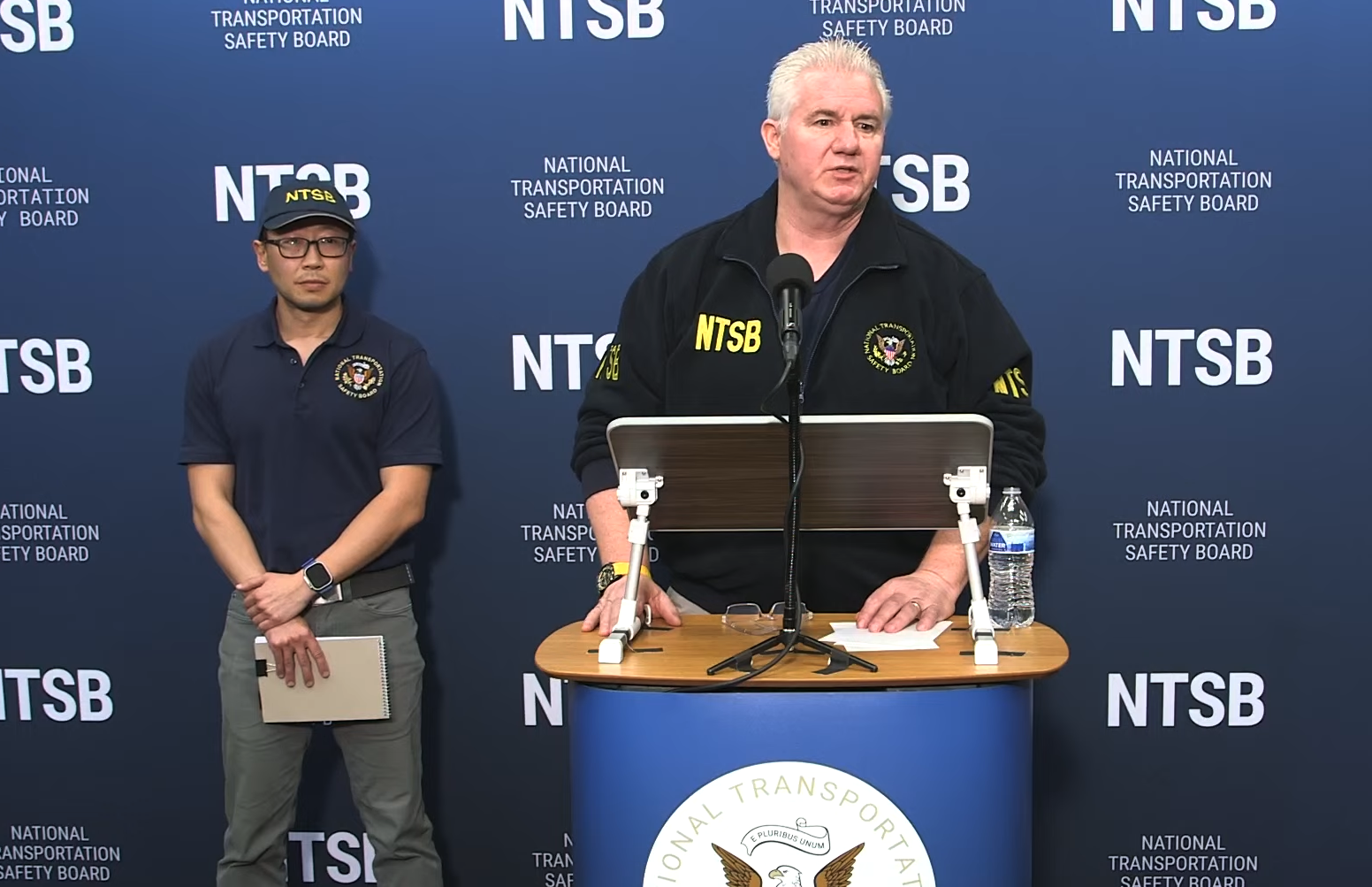

The National Transportation Safety Board (NTSB) briefed the press on the latest details of its investigation into the crash of a UPS MD-11 for the final time on-site Friday. The cargo aircraft crashed on takeoff in Louisville, Kentucky, on Tuesday.
NTSB Member Todd Inman said the cockpit voice recorder (CVR) captured two hours and four minutes of “good quality” audio, providing investigators with important insights about the flight’s final moments. According to Inman, the crew’s takeoff roll was uneventful until a repeating bell was heard roughly 37 seconds after takeoff thrust was applied, persisting for 25 seconds until the end of the recording.
The NTSB will form a dedicated CVR group at its Washington headquarters to analyze the recording and produce a full transcript.
Debris Field Remains Active as Investigators Secure Evidence
Inman said he spent several hours at the debris field Friday, describing it as “still active in more ways than one,” with spot fires occasionally reigniting among compressed paper products. More than 100 first responders remain on site, and over 500 personnel have been involved in the initial response or investigation so far. Because additional water or firefighting foam could disturb evidence, crews are maintaining a careful balance between safety and preservation of the scene.
He added that the agency has recovered the left engine pylon, which remained attached to the engine when it separated from the wing. Both components are being examined at a secured facility. Investigators have completed LIDAR scans of the airfield and surrounding terrain to assist with mapping and debris analysis, and specialized salvage crews are preparing to move heavier wreckage off site for further study.
Technical Review and Coordination Continue
Inman said the team is correlating flight data recorder (FDR) information with ADS-B data provided by the FAA, noting that early readings suggest the aircraft was about 100 feet above ground level at its lowest recorded point before impact. That data validation process, he said, will take several days.
Investigators are also gathering and analyzing maintenance records from a recent heavy check performed in San Antonio. The FAA is providing assistance with retrieving documentation from the repair facility. UPS will be providing an “exemplary aircraft” of the same MD-11 configuration for comparative inspection, and NTSB operations staff will use a simulator to study cockpit scenarios, Inman said.
The NTSB confirmed that the FBI is continuing to assist with making safe several hazardous materials at the site.
Next Steps in the Investigation
Friday’s briefing was the NTSB’s final on-scene update. Inman said subsequent updates will come through official press releases and investigative reports from Washington, D.C. The agency will remain in Louisville as long as necessary to collect perishable evidence before shifting focus to laboratory analysis.
“We’re not going to leave until we know that we’ve secured all of the perishable evidence and all the information that will be necessary to come out with the most comprehensive investigative report,” Inman said.


Does 100 feet mean when recorder stopped, or the maximum altitude achieved?
The way it’s written doesn’t make any sense. How can a flight be at 100’ AGL at its lowest (yes despite the context being “recorder stopping”). Recorders are wired to be the last thing to shut down eg battery bus.
Earlier ADS-B reported an altitude of 350’.
Almost every article written by this bozo contains major mistakes. Doesn’t avweb have an editor who knows something about aviation, common sense, or English?
Read what it says before going off on one!
What are your issues with the article? Could it be that you are the …?