




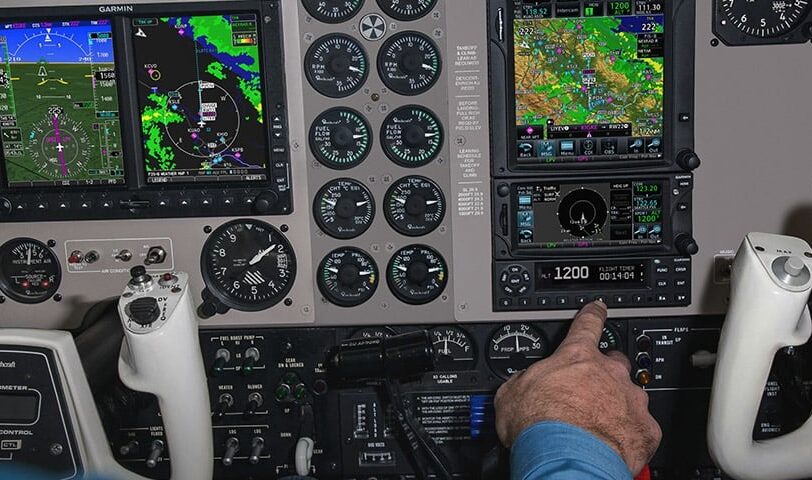

Australia is advancing toward universal fitment of Automatic Dependent Surveillance-Broadcast (ADS-B), with the federal government releasing a consultation paper that outlines mandatory requirements for most Australian aircraft beginning in 2028. The proposal would phase in ADS-B Out capability across airspace classes, with some operators permitted to use approved electronic conspicuity devices in lieu of full installations.
The plan builds on commitments in the 2024 Aviation White Paper, which identified ADS-B as critical to collision avoidance, air traffic efficiency, and the integration of advanced air mobility.
Industry consultation is ongoing, but the Department of Infrastructure, Transport, Regional Development and Communications described the potential mandate as “a major safety improvement,” according to an Australian government statement.
The effort coincides with an ongoing government rebate program designed to incentivize voluntary equipage through 2027. Officials have noted that utilizing such equipment will increasingly be necessary for safe operations in increasingly complex skies as uncrewed systems and eVTOL aircraft emerge in the next decade.
Conversation Relevant to U.S. BVLOS Proposal
The conversation mirrors parts of certain developments in the United States, where the FAA’s draft Part 108 rules for beyond visual line of sight (BVLOS) operations would require drones to yield to manned aircraft only if those aircraft are electronically conspicuous through ADS-B Out or a low-cost portable device. Aircraft without such equipment would not automatically retain right-of-way.
Both the U.S. and Australia are signaling that widespread adoption of ADS-B or electronic conspicuity will be central to safely integrating drones and advanced air mobility into shared airspace.


Very clever of the FAA. If your aircraft has ADS-B out, the drones must yield to you. If your aircraft doesn’t have ADS-B out, you become a drone target! You have no right-a-way over the drone…even if you are on the right side of the drone. A clever way to force everyone to have ADS-B out. Do you ever get the feeling that our government is completely out of control?
Yes, but drones need a way to detect nearby aircraft reliably even in bad weather. Visual and audible sensors are not adequate in bad weather. Transponders squawking Mode C don’t provide precise enough location information. ADS-B Out squawks latitude, longitude and altitude every second. There are sometimes false indications with ADS-B Out but it’s more reliable than other methods. I think it would have been better for the government to revive financial reimbursement for ADS-B Out installations like they did when it was first mandated but any incentive to equip is good.
And what about all the planes that do not have an engine driven electrical system? The FAA currently does not allow portable ADS-B out transmitters. All those J3 Cubs and Champs will be at the mercy of a drone that can’t see and avoid? What about gliders? If the FAA goes through with this it will be another way to end VFR flying as we currently know it. I wonder how long it will be before the FAA enacts a maintenance rule like transponders have now for ADS-B.