




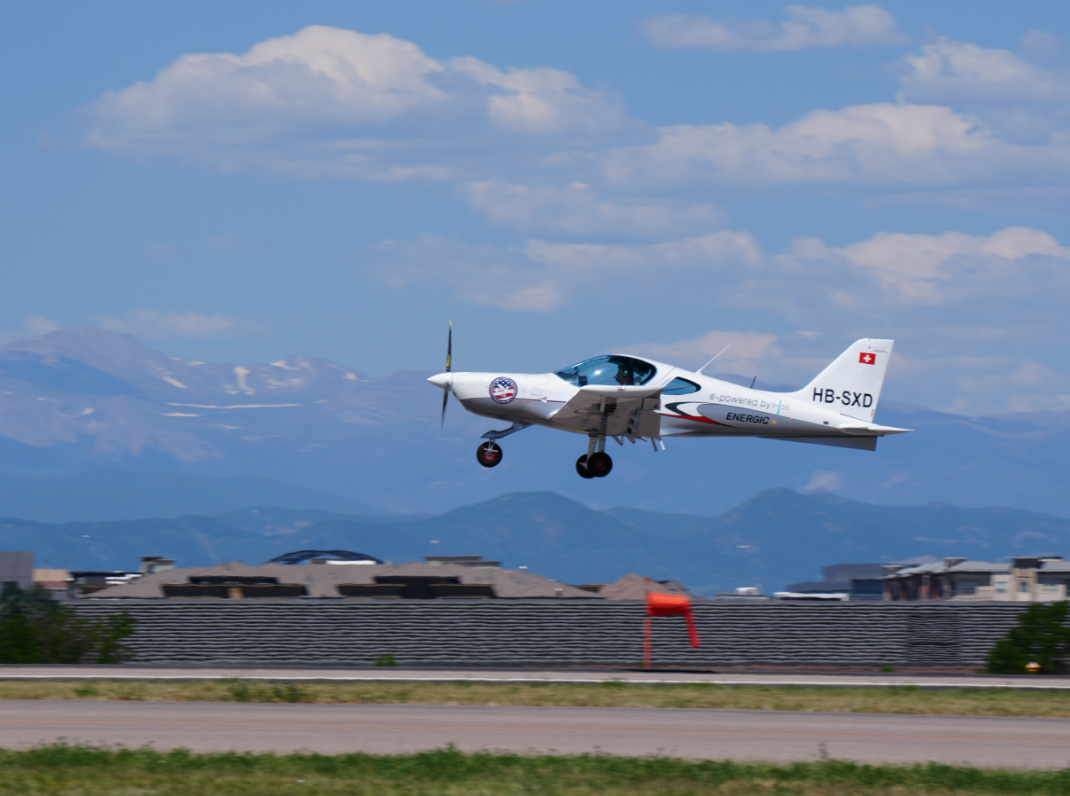

Centennial Airport-based flight school Centennial Flyers has ordered six all-electric Bristell B23 Energic training aircraft powered by Swiss manufacturer H55, becoming the first operator in Colorado to introduce the model and H55’s first U.S. fleet customer. The aircraft are planned for use in the school’s training program.
Bristell’s avgas-powered B23 earned FAA type certification in September.
“Centennial Flyers is proud to bring electric flight to Colorado, pioneering and leading the transition to cleaner and quieter aircraft,” President Scott H. Smith said.
He added that members will train in “the most technologically advanced trainer in the world.”
The order follows a July Letter of Intent signed during H55’s “Across America” tour stop at Centennial Airport, where the B23 Energic participated in official noise tests. According to airport officials, the aircraft’s sound levels were low enough that several monitoring stations did not register the aircraft above ambient noise. Centennial Flyers expects to receive its first two aircraft in 2027, with four additional units planned for 2028, though the delivery timeline may change.
H55 said the agreement reflects growing interest in electric aircraft among training providers.
“We are thrilled and also proud to support Centennial Flyers, the first U.S. fleet customer of H55, as they adopt six H55-powered B23 Energic aircraft,” Kristen Jurn, H55’s North America sales manager, said. Centennial Airport Executive Director Michael Fronapfel said the quiet operating characteristics of electric aircraft will affect surrounding communities and noted the airport’s ongoing work with tenants and partners on emerging flight technologies. The airport secured a $300,000 grant last year aimed at supporting a subsidy for unleaded aviation fuel sales.

Aircraft cost? Range & endurance? Useful load? Life of battery? Recharge time? Where does the airport get its power - probably coal and natural gas. Aviation diesel engines are also very quiet, see Diamond aircraft. Far more efficient and better for the environment than batteries.
Aircraft cost about $431,000, Endurance 1 hr with 30 min reserve, useful load 190 kg (418 lb), life of battery, 1000 cycles, time to recharge 1 hr. But the real number that matters most is cost of operations – about $7 hr assuming a cost of electricity of $0.20 per kWhr. Also, very little maintenance. (I drove my Chevy Bolt EV, 105,000 miles and except for tires, the total maintenance except for tires was changing the rear wiper blade twice.)
Looking at the where battery energy density is going, we already have lithium sulfur cells available in test quantities that have about twice the energy density of the current lithium ion with lower projected cost and a projected energy density of 3 times by 2030. This would provide 3 or 4 hours of range. Like it or not, this is the future and I can not wait to have an electric powered plane.
There is no case where fuel burning vehicles are less dirty than battery vehicles; none.
To say otherwise is repeating fossil fuel propaganda.
The airport could put in solar panels with storage; free “fuel” forever.
Kent, those are all good questions that I’m sure you can get answered if you just go to the manufacturer information..
But for the remainder of your comment, I want to remind you that airports get their energy from the same place as everybody else on the earth.
This makes total sense for a training operation.
Cheaper, quieter, more reliable, less maintenance.
Airports are a perfect venue for solar power with storage.
The cheapest, fastest to build, most reliable, most available power source; by far.
Hangar roofs and open spaces;
Free “Fuel” forever!
New battery technologies currently in Beta testing will make electric aircraft good for several hundred miles of range.
A Sling LSA which is similar in size is $140,000-$180,000.
It easily trumps this e-plane in range, endurance, and refueling time and practicality. Especially as a cross country airplane. At 1/3 the cost! If the flight school would forgo their virtue signaling they could have 3 times the airplanes, and each one would be better.