




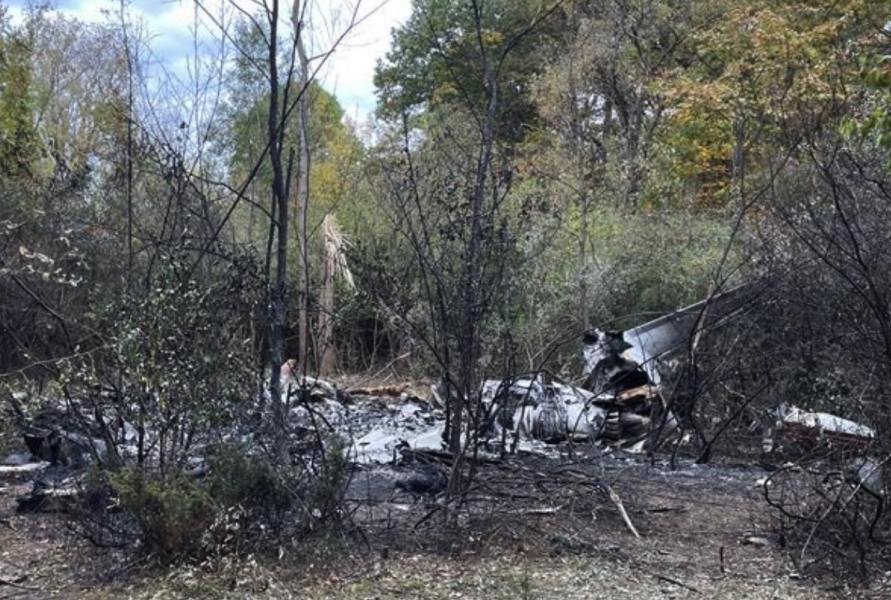

Federal investigators said the crew of a Raytheon Hawker 800XP that went down near Bath Township, Michigan, last month reported they were in a stall moments before the jet entered a rapid descent, according to a preliminary report released this week by the National Transportation Safety Board (NTSB). All three people on board, including both pilots and one passenger, were fatally injured in the Oct. 16 accident.
Post-Maintenance Stall Test
The aircraft, operated by Aerolineas del Centro, had been undergoing routine work at Duncan Aviation’s Battle Creek facility since March. One inspection required the removal of the wing leading edges and ice-protection panels, which triggered a mandatory post-maintenance stall test flight before the jet could return to service.
Maintenance personnel told investigators the crew, whose logbooks both indicated they flew this aircraft exclusively, was provided a list of qualified test pilots to perform the stall test. When efforts to schedule one were unsuccessful, the crew elected to perform the test themselves.
The crew typically flew the Hawker about 150 hours per year, the report said, and most recently received simulator training earlier this year in March.
Descent and Final Transmission
ADS-B data showed that the Hawker departed Battle Creek and climbed to FL150 roughly nine miles northeast of the airport. About 19 minutes into the flight, the jet began a rapid descent from FL140. Air traffic control attempted to reach the crew, who replied, “we are in a…,” followed by a transmission in Spanish that translates to “in a stall, recovering, sorry,” according to the NTSB. No additional transmissions were received.
The aircraft impacted wooded terrain in a relatively flat attitude, the report said, and a post-impact fire destroyed most of the wreckage. Even so, investigators reported that all major structures were located at the site.
Stall Characteristics Noted in Manual
The report notes that the aircraft’s Pilot’s Operating Manual states that the Hawker 800XP provides no natural stall warning before reaching a stall and cautions that rolling tendencies or aileron snatch may occur. It dictates that stall tests must be conducted in daylight visual conditions with specific configuration requirements, including an operative stall identification system and autopilot disengaged.
Investigators from the NTSB, FAA, Textron Aviation and Honeywell completed an initial on-scene examination Oct. 18–22. Analysis of the aircraft’s cockpit voice recorder is still pending, but the recorder is with the NTSB’s laboratory in Washington, D.C.


0 replies