





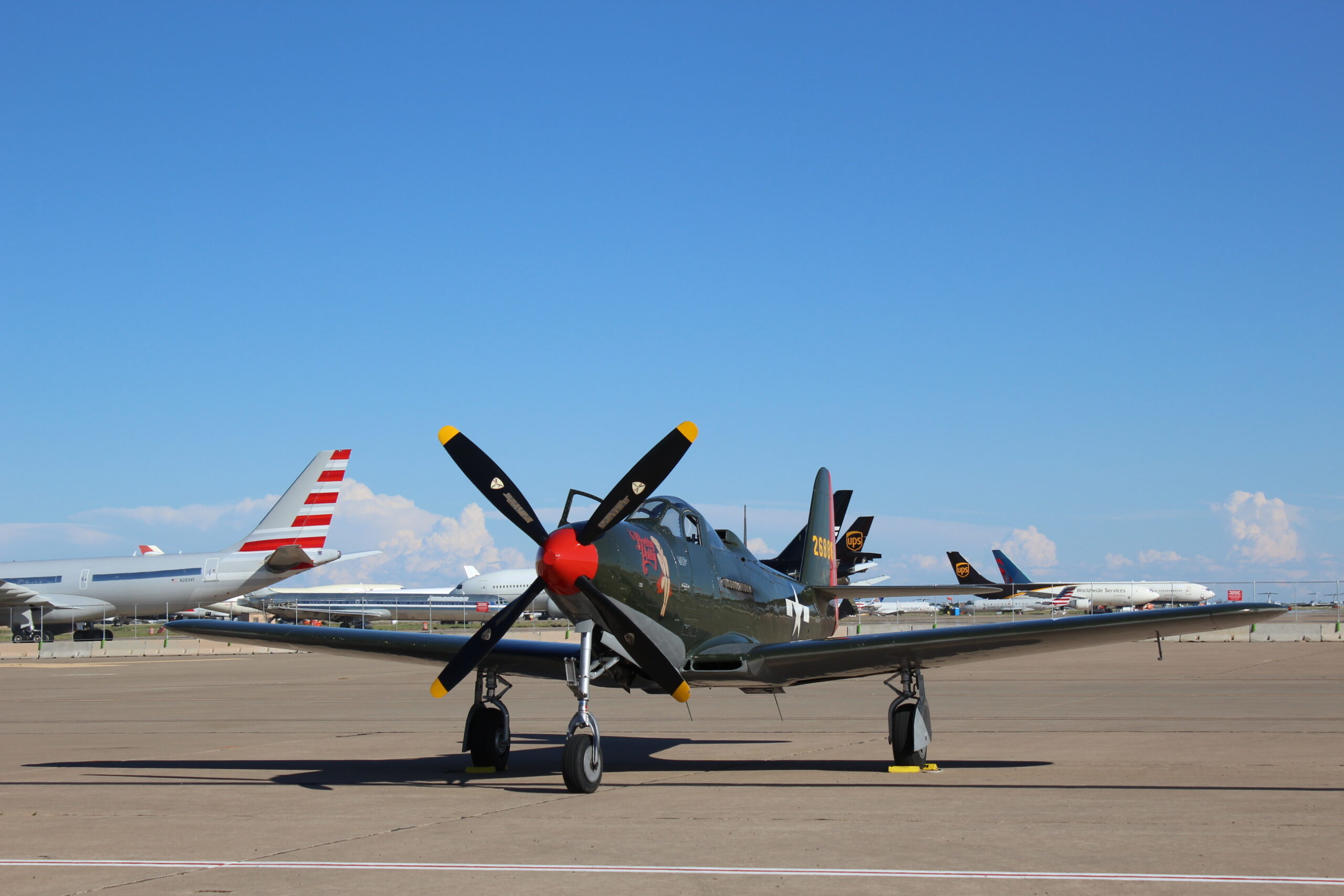

Among the rarest warbirds flying today, the Bell P-63 King Cobra “Pretty Polly” drew plenty of attention at the Roswell Air Races. Piloted by Pat Nightingale of the Palm Springs Air Museum in Palm Springs, California, this aircraft is one of only four P-63s still airworthy worldwide.
The P-63 was originally designed by Bell Aircraft as a quick-attack fighter. But when the U.S. military shifted priorities to long-range bomber escort missions in Europe, its limited range left it overshadowed by the P-51 Mustang.
Learning to Fly a Relic
For a pilot, the challenge isn’t just flying a rare airplane—it’s learning to fly one when so few people alive still know how. Nightingale began flying the King Cobra in 2013, starting with ground school and training in a North American T-28 Trojan under the guidance of another pilot with P-63 experience.
“I had to get training in a T-28 for two to three flights,” Nightingale said.
Quirks in the Cockpit
Nightingale describes the P-63 as a rewarding but peculiar machine.
“A P-51 Mustang is like a Cadillac compared to the P-63,” he said.
Unlike the Mustang, which was engineered with vibration-dampening mounts, the King Cobra’s engine is bolted directly to the airframe. That placement—behind the pilot, with a driveshaft running forward through the cockpit to the propeller—creates heavy vibration throughout the airplane.
The quirks don’t stop there. The P-63’s nosewheel isn’t steerable, requiring brake pressure to turn. And its long, canoe-like forward fuselage makes ground handling especially tricky.
“The aircraft structural strength is like a canoe, it’s strong but not particularly rigid. The nose will wander due to the structure,” Nightingale said, noting the difficulty of taxiing.
Heat in the Cockpit
Flying with the engine directly behind the cockpit brings another challenge—heat. Temperatures can soar to 125 degrees, and a shelf behind the seat can turn into a miniature oven.
“I had several items that were plastic in my backpack that started to melt,” Nightingale said.
A Brief History
Bell built about 3,000 P-63s in total. Roughly 2,000 were shipped to Russia under Lend-Lease, with the remaining 1,000 staying in the United States. Today, only a handful remain, with the most recent loss taking place in the Wings over Dallas airshow collision between a P-63 and a B-17 in Texas back in 2022.
The Palm Springs Air Museum’s “Pretty Polly” offers a rare chance to see one, and it was a privilege to watch one in flight at Roswell.


0 replies