


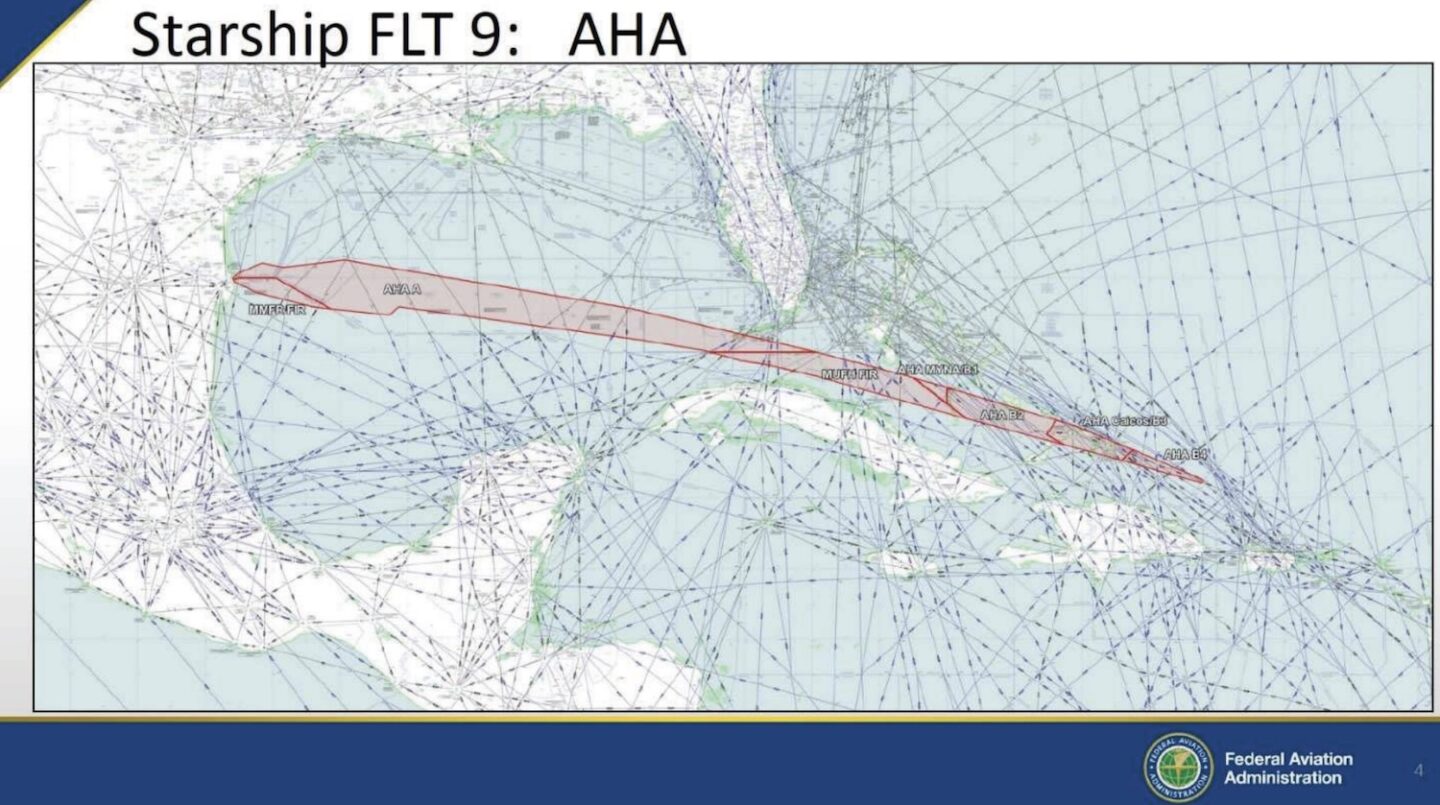

The FAA has expanded the “aircraft hazard area” for SpaceX’s ninth test launch of its Starship system in hopes of avoiding the air traffic scramble that resulted from the previous two failed launches. In January and March, Starship vehicles disintegrated over the Caribbean, diverting aircraft in flight and grounding others. For the next launch, which could happen as early as Tuesday, the agency has declared a 1600-nm hazard area stretching from the launch site in Starbase, Texas, to the Turks and Caicos. In the previous flights, the corridor was about half that size. The agency said the expansion was done because of the previous experience and because there’s a new element of risk with this launch.
For the first time, SpaceX will be using a refurbished Super Heavy booster rocket that had been used and recovered on the launch tower on one of the previous flights. The primary mission is to test a new heat shield on the Starship. The vehicle will splash down in the Indian Ocean if the flight goes as planned. The previous two tests ended before the shield could be used. It’s suspected fuel leaks caused by stronger than expected vibrations brought those vehicles down. Fuel lines have been rerouted and bigger propellant tanks installed. New control flaps have also been installed.
Approval for the launch was granted by the FAA late last week and the posting of warnings suggest the earliest launch time is the evening of May 27. SpaceX has been told to schedule the launches for “off-peak” hours for air travel and the FAA says flight delays of from 40 minutes to two hours are anticipated to accommodate the flight.

Can you imagine if Boeing had such an abysmal record with their SLS?
It is impossible to compare the Boeing SLS with Starship, and by extension NASA’s incompetence with present day metrics for success.
The Starship has had 8 launch attempts and 4 successful flights, each one a learning datapoint.
The Boeing SLS was poorly concieved and ill planned. Twenty Four Billion spent with little to show for it. Think about this. Every “successful” launch of the SLS “should it happen” means the expenditure of $2.5 Billion dollars and the total loss of the rockets and all parts they contain. There are only enough for 8 launches anyway so once they are gone you have to redesign the whole thing. So after its "done the $50 billion spent gets us back to where “NASA” has to contract to use the Starship anyway.
The SLS cost 24 billion for one launch and the “dream” of Artemis. They can’t even make a capsule. The rest is beyond their ken…
Compare that with a $100M USD starship launch cost and the total development cost of between 5 and 10 Billion dollars. Oh, and the rocket is reusable.
The NASA and Boeing cooperation on SLS is a national embarrassment. The biggest difficulty NASA will have is deciding when to preserve their legacy (achivements 50+ years ago) against curtailing the continued damage they do to their brand with each successive failure or poorly thought out solution. For an agency that has 50 years of unimpressive results with EACH PROGRAM, at some point damage control must become a priority.
Place SLS in a museum as a datapoint for humans “This is what not to do” and stop the madness.
There are two different questions here. First, did the system specifications bidders were given for SLS ask for the right system, and has execution on the project as bid been reasonably conducted. I think we’d agree the answer to the first question, in hindsight is probably not. I am not involved to have an idea how to answer the 2nd question. Over the years I’ve seen some reports that indicate some very useful engineering, materials, and manufacturing techniques have been developed in the SLS program. I hope that learning can translate to something of more lasting value for the money spent. You can look back at Apollo and the Shuttle and say the same thing. The system requirements and resulting designs were not the right thing by current standards, but they enabled progress and the money spent was of long term value.
However neither of those are the point of my original post which was that there is a double standard. If Boeing were doing a project with successes and failures that paralleled those of SpaceX they’d still be ridiculed in a way that SpaceX is not. The same could be said for NASA, at this point they could not afford a string of failures and the condemnation it would bring from the public and Congress.
The fact is that the system specifications were designed to be a boondoggle, a rocket system that was both monolithic and ultimately useless, in other words a perfect NASA program in many respects.
I have not seen any “useful” engineering, material advancement or manufacturing techniques because the reasons for engineering have become obscured. The Starship is made of Stainless Steel, against all of the discardable exotica and super technology that SLS simply allows to burn up. Thats the difference. Make it simple, make it cheap enough to make money with, and repeat. The rocket scientists at NASA design a new coffee cup before every break I would guess, and think that is a reasonable day at work. It’s tiresome and disgusting. But you are right about the double standard. Just not directionally.
Double Standard Example:
Boeing’s Starliner is a great case in point as all they had to do is design a reusable capsule.
Boeing was allocated a $4.2B fixed price contract in 2014 from NASA.
SpaceX was allocated $2.6B to develop Crew Dragon from NASA.
Boeing spent $6.5B on Starliner and was two years late. Abort test was 2 out of three chutes, still a “pass”, Failed the first flight 12.2019, second flight also had many many failing thruster issues but was considered “a pass”, third launch attempt was the crewed one, and that was a bust too. In fact, the whole thing is a mess, and the punch line…? The Boeing re-usable vehicle is designed for just 10 flights. So much for reusability.
Meanwhile Crew Dragon has 19 successful flights, and Cargo Drago 12. No failures. So yes, it’s a double standard. One group is professional, the other is an embarrassment.
I would propose that No Taxpayer funded NASA program should be allowed to exceed $50M USD in cost unless SpaceX signs off on its feasibility and ROI to the taxpayer. We are sick of their waste.
Looks like Elon had another rough night.