


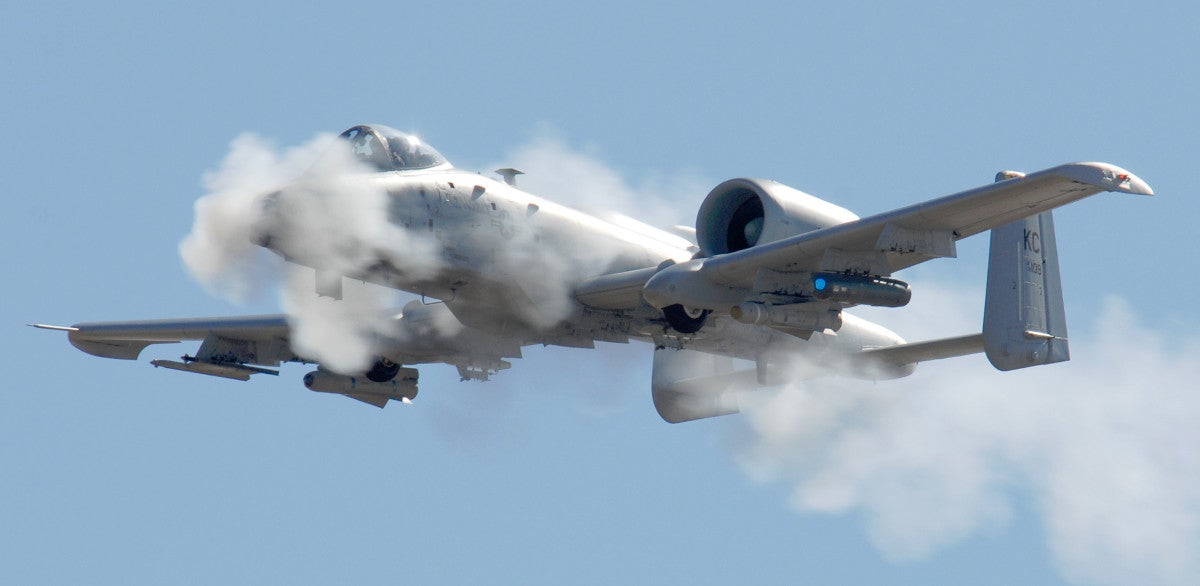

Key Points:
-162 Warthogs to be decommissioned
-F-35s and F-15s assume ground attack role
-350 other aircraft to be retired
The last flight of the Air Force’s A-10 Warthog close support aircraft will occur in 2026 as part of a budget cut. The beloved attack plane was supposed to be in service through 2028 but the early retirement was included in the Air Force’s 2026 budget request. “The probably key one that most folks will want to be aware of is the Air Force will divest the remaining 162 A-10 aircraft,” a senior defense official told reporters last week “They were originally set to divest over a time period into ’28. We’re set to divest all of those in ’26.” It will cost $57 million to get rid of the Warthogs.
The Air Force has been trying to retire the popular aircraft for at least a decade, saying it is outdated and will be a sitting duck on a modern battlefield. But members of Congress and former military leaders have launched a nostalgic battle to keep it in the inventory based on its past successes in combat. Meanwhile, the Air Force has asked for $10.3 billion for B-21 stealth bombers, 47 F-35s, 21 F-15E Strike Eagles along with $3.4 billion for development of the F-47 sixth-generation fighter. The F-35s and F-15s are both used as ground attack planes. In addition to retiring the A-10s, the Air Force will get rid of about 350 old aircraft, including KC-135s, F-16s and a variety of helicopters.

As a retired military type who served on the A-10 Test Team, this is not only heart breaking but a gigantic mistake. Ask the Ukrainians if they’d like to have a couple dozen of 'em in their ‘modern battlefield’ environment. In the McKinley Climatic Test hangar during cold testing of the airplane, I was IN the hangar and adjacent to the GAU-8 when 30 rounds were shot into a specially made bullet catcher. NO OTHER AIRPLANE will ever be anything but a pea shooter next to that thing. Who the hell is running MY USAF ??? Whoever they are … they’re penny wise and dollar foolish. I’ve talked to grunts who have been saved by this thing … they’d say the same thing, too.
@LarryS The A-10 earned its legend the hard way. No one who’s seen it work up close doubts what it brings to the fight. The GAU-8 isn’t just a gun. It’s a statement. Plenty of grunts are alive today because the Warthog showed up when nothing else could.
But the battlefield has changed. It’s not about whether the A-10 can kill tanks. It’s about whether it can survive long enough to do it. The A-10 entered service in 1976. It was built for Cold War tank-killing in Europe and proved itself in Desert Storm, Iraq, Afghanistan, and Syria. But those were different wars.
Today it faces kamikaze drones, shoulder-fired missiles, loitering munitions, cyber disruption, and runway strikes. None of that was part of the fight when the Warthog was born. Now low and slow just makes you an easy target.
You’re right that Ukraine would take a squadron of them in a heartbeat. But even they’re finding out the hard way that without air superiority and drone suppression, CAS platforms like the A-10 are toast.
The problem isn’t the gun. It’s the logistics. Fuel, parts, crews, runways, all of it is exposed. Until we figure out how to protect that, nothing flies for long. Old or new.
You’ve been wrong before. But not this time. It is heartbreaking. Just not surprising. Goin’ to bed now. Might dream of that BRRRRT one last time.
“It will cost $57 million to get rid of the Warthogs.”
It would cost nothing to let museums, the CAF, or rated individuals to have them for free.
Today it faces kamikaze drones, shoulder-fired missiles, loitering munitions, cyber disruption, and runway strikes. None of that was part of the fight when the Warthog was born. Now low and slow just makes you an easy target.
Most of the limitations listed are ground environment vulnerabilities that apply equally to fast movers like the F-16 or F-15EX. Low and slow has always been dangerous, and low and fast isn’t all that much better. I flew missions as a Stormy fast FAC in Vietnam. The time of flight for the bullet is short, and lead angles for a head on shot and small. But the A-10 was built with those vulnerabilities in mind - a titanium tub surrounds the pilot, the aircraft has multiple flight control redundancies, and the engines are (somewhat) shielded from shoulder-fired SAMS.
I have always wondered why the A-10 is considered so vulnerable while attack helicopters continue to be designed and in service.
$57M to decommission the remaining 'Hogs is a bargain, but I’m betting that it merely mothballs them at Pima. Getting them into museums is a whole 'nother, and much more expensive, endeavor. As much as I’d love to see a two-ship A-10 aerobatic-and-ground-attack routine at Airventure (they’ve been there in the past) that would be quite an investment with a long payback.
Pima is a museum, not a boneyard. That is at Davis Monthan AFB.
The A-10 was brutally effective. No frills, no flash. Two GE turbofans strapped to a flying tank, wrapped around a 30mm cannon the size of a hot dog stand. It wasn’t made to impress. It was made to finish the job and stick around while doing it.
Some ask why the A-10 is considered vulnerable while attack helicopters remain in the fight. That takes me back. My OJT in airmobile warfare came in Vietnam, ’65 to ’66. We flew in on Hueys, skids hitting the LZ just long enough to jump before someone opened up with a Chinese .51 or an RPG. Not the safest ride, but they got you in. Sometimes they got you out.
We knew helicopters were fragile. Doors open, M60s hanging, pilots exposed. Later came rocket pods. Then Cobras, sleeker and tougher, but still not built to take sustained fire. They were lifelines, not brawlers. When we needed someone to circle the fight and slug it out, that was fixed-wing CAS.
I watched Skyraiders do that. Low, slow, steady. They took fire, dropped their ordnance, and came back again. When Spooky lit up the jungle near War Zone D, it didn’t just rattle trees. It changed the fight.
The A-10 picked up that torch. In Desert Storm, Kosovo, Iraq, Afghanistan, and Syria, the Hog proved its worth. That BRRRRT wasn’t just firepower. It was a promise.
I never heard it in Vietnam, but I came to know what it meant. I heard what came before it, and I understood its place. Someone up there hadn’t forgotten you.
But the battlefield changed. Drones, loitering munitions, shoulder-fired missiles, GPS jamming. Threats come fast and cheap. Even the Hog can get hit before it gets close. Meanwhile, helicopters have evolved. Countermeasures, stealth shaping, real-time networks. The A-10 hasn’t.
There’s some nostalgia in holding on to the Hog. I know that. With its plain looks and bruiser frame, it reminds me of the Skyraiders. Maybe there’s a little Don Quixote in me, tipping my helmet to a jet built for a kind of war that’s fading.
But the memory stays. And so does the respect—for what the Hog did, and what it meant.
Just an old man, remembering what I once saw as a young infantryman–the guy with the 1911.
Well … by that definition, Raf, almost everything is vulnerable. Sometimes, the loss of an airplane is preferble to the loss of a whole bunch of ground pounders ?? Didn’t you see the A-1’s ?
See:
Showing your ignorance yet again. When an airframe is de-commissioned they go through several processes. First is de-activation, where military equipment and/or scarce items are removed. Then comes storage at whatever readiness level is appropriate (some aircraft are stored requiring very little to re-activate). Once earmarked for disposal they must be made safe with all dangerous materials removed and the airframe made environmentally safe. THEN you can either scrap them, or sell them / donate them to museums.
Lovely sound of A-10’s at Airventure:
Let’s not forget potentially disabling them (e.g., cutting the wing spars), at least for more current designs.